Reports and articles
The Swiss paradox: a services reputation built on an industrial and innovation powerhouse
Published on February 3rd 2026
By Jennifer Castañeda-Navarrete, Cambridge Industrial Innovation Policy
Switzerland is one of the wealthiest and most innovative countries in the world. The country ranks among the top 10 economies in terms of gross domestic product (GDP) per capita, having one of the lowest unemployment rates among OECD countries. Switzerland has also been recognised as the most innovative country for 13 consecutive years by the Global Innovation Index.
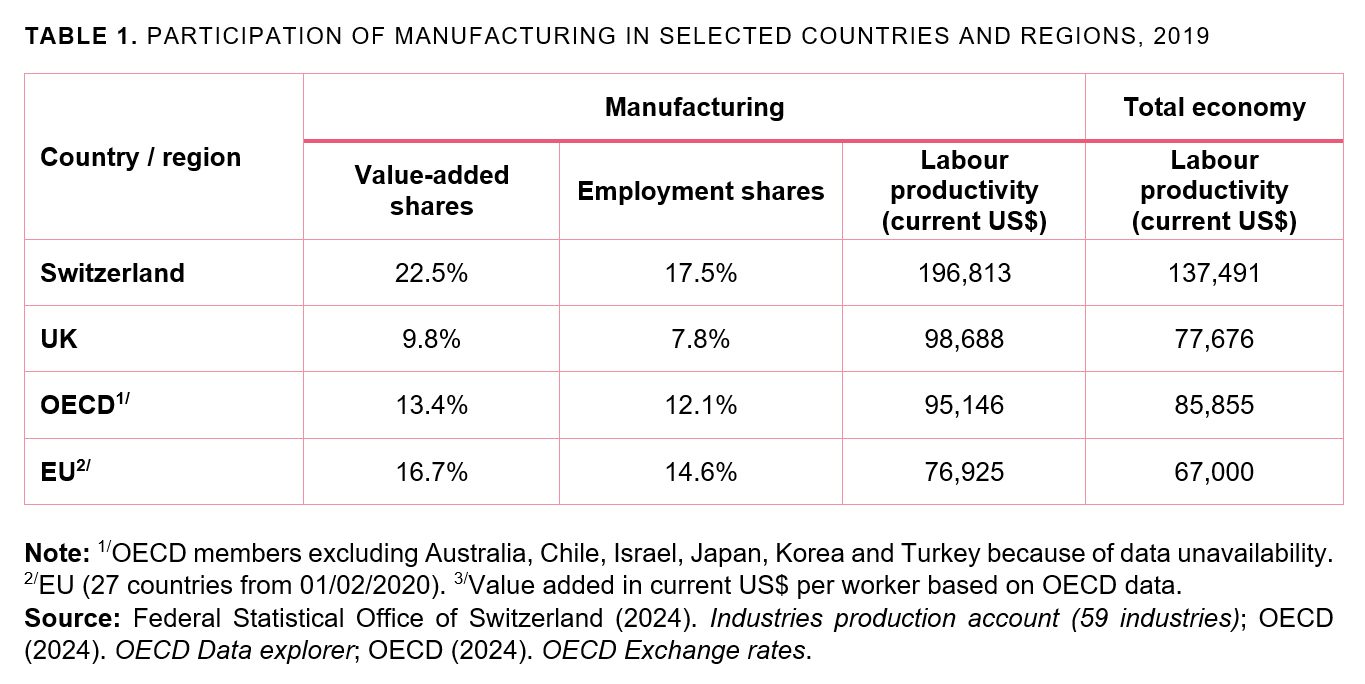
Although commonly portrayed as a services-oriented economy built on finance and high-end tourism, manufacturing remains central to Switzerland’s prosperity. Manufacturing accounts for 22.5% of the economy and 17.5% of employment, far above the averages for the EU and the OECD, and more than double the share observed in the United Kingdom (Table 1).
The country consistently outperforms its peers in productivity, owing in part to the dynamism and substantial scale of its medium- and high-technology industries. Two sectors are particularly prominent: pharmaceuticals and the mechanical, electrical and metal (MEM) industry.
Pharmaceuticals: a driver of productivity growth
Pharmaceutical manufacturing is Switzerland’s most productive and fast-growing industry. In 2019 its labour productivity was nearly five times the national average and significantly higher than both OECD and UK benchmarks. Between 2012 and 2019, the industry contributed more than 14% of total economic growth, driven by strong value-added expansion and sustained investment in research and development.
Pharmaceutical firms account for almost half of all business R&D expenditure in Switzerland, underlining the sector’s central role in the national innovation system. The industry is also deeply export-oriented. In 2023 Switzerland was the world’s second largest exporter of pharmaceutical products, accounting for 12% of global exports.
The MEM Industry: an industrial pillar at a turning point
The MEM industry—encompassing computer, electronic and optical products; watches and clocks; machinery and equipment; metals; and transport equipment—is Switzerland’s largest industrial employer, with more than 320,000 employees. It also plays an important role in research activity, contributing 14% of business R&D expenditure in 2019.
Within the sector, computer, electronic and optical products, and watches and clocks stand out for their productivity performance, with productivity levels 1.4 times the national average. Watchmaking remains a flagship Swiss export, representing 7.1% of goods exports and accounting for around half of global watch exports in 2023.
However, the MEM industry faces competitive pressures. While it contributed one-fifth of national economic growth between 1998 and 2007, its contribution fell to just 1 per cent between 2012 and 2019. Nonetheless, the sector showed notable resilience during the COVID-19 pandemic, when it accounted for more than 31.2% of Switzerland’s economic growth.
Lessons for advanced economies and challenges ahead
Switzerland is widely recognised as one of the most innovative and competitive countries in the world. Its success reflects a combination of factors: a robust high-tech manufacturing base, innovation-intensive industries, a highly skilled workforce and a strong export orientation. Together, these elements demonstrate the enduring value of an industrial structure anchored in advanced technologies and supported by world-leading research capabilities.
However, as in many advanced economies, Switzerland faces growing competitive pressures. Firms are shifting towards more incremental forms of innovation, and an increasing share of research and development activity is being located abroad. These developments raise concerns about the future depth of the domestic knowledge base and the long-term retention of high-value activities.
Sustaining competitiveness will require continuous renewal, particularly in the context of intensifying global competition and rapidly evolving innovation strategies. Nonetheless, the Swiss federal government is responding to these challenges by, among other measures, expanding its industrial technology-transfer infrastructure, with a focus on emerging technologies.
This article presents findings from our recent policy paper, Swiss Made: The Role of Manufacturing in Switzerland’s Success. The brief examines Switzerland’s economic structure and performance between 2012 and 2021, highlighting the drivers of its global leadership and the contribution of manufacturing and knowledge-intensive services. Given their central importance, the analysis explores in greater depth the pharmaceutical and MEM industries. The policy paper forms part of a broader series assessing how sectors shape national economic performance across diverse contexts.
Download the report: Swiss made: the role of manufacturing in Switzerland’s success
Get in touch to find out more about working with us