Reports and articles
Why have the G7 countries had slow growth rates since 1990?
Published on July 23rd 2026
For more than three decades, the pace of productivity and economic growth in advanced economies has slowed significantly. Much of the debate has focused on domestic factors such as investment, skills, innovation, institutions and market dynamics. This policy brief explores whether changes in the global economy also played an important role.
Authored by Lord David Sainsbury, Carlos López Gómez and Michele Palladino, Why have the G7 countries had slow growth rates since 1990? examines how the rise of China, India and other emerging economies transformed the competitive environment facing advanced industrial economies, and how these changes may have influenced long-run productivity growth.
Drawing on international evidence on productivity, trade and structural change, the brief presents evidence that the slowdown observed across all G7 economies from around 1990 cannot be fully understood through domestic factors alone. Instead, it considers how the expansion of global value chains, the redistribution of productive capabilities and changing patterns of international competition reshaped the structure of advanced economies over the past three decades.
A changing global economy
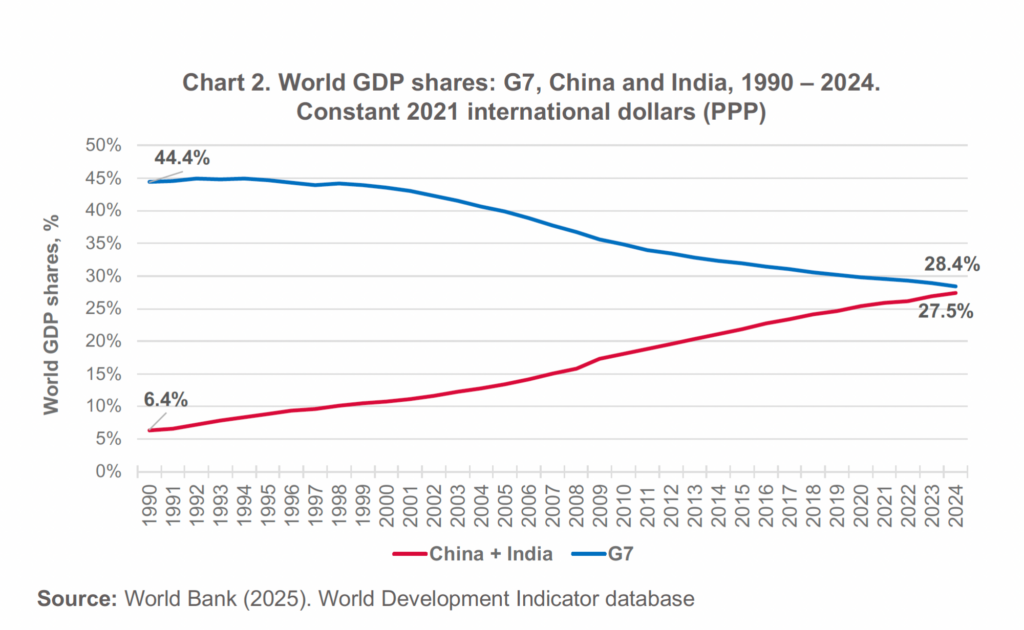
The transformation of the global economy since 1990 has been remarkable. In 1990, the G7 accounted for almost half of global GDP, while China and India together represented less than one-tenth. By 2024, the G7’s share had fallen to just over one-quarter, while China and India’s combined share had risen to almost the same level.
In little more than three decades, the centre of gravity of the global economy shifted significantly towards Asia.
The brief argues that this shift represented more than a change in economic size. As new productive capabilities emerged and global value chains expanded, firms transferred production, knowledge and technological capabilities across borders, creating new centres of industrial competitiveness and reshaping patterns of industrial specialisation across advanced economies.
“The rise of China, India and other emerging economies fundamentally changed the competitive environment facing advanced economies. Understanding how that shift reshaped industrial structures is essential to explaining productivity growth over the past three decades.”
Dr Carlos López-Gómez, Head of Policy, Cambridge Industrial Innovation Policy
Rethinking productivity slowdown
The policy brief presents evidence that productivity growth slowed across every G7 economy from around 1990 onwards, despite substantial differences in national institutions, industrial structures and economic policies. This common pattern suggests that changes in the global economy deserve a more prominent place in explanations of the productivity slowdown.
It argues that the rise of China, India and other emerging economies reshaped patterns of industrial specialisation across advanced economies, with important consequences for long-run productivity growth. As manufacturing declined across many advanced economies and countries differed in their ability to develop other high-productivity activities, these structural shifts increasingly influenced long-term economic performance.
The brief concludes by considering what these developments mean for industrial strategy, innovation policy and long-term economic growth.
About the authors
Lord David Sainsbury is Founder and Chair of the Gatsby Charitable Foundation and has written extensively on industrial strategy, innovation and economic growth. He served as the UK’s Minister for Science and Innovation from 1998 to 2006. Carlos López Gómez, Head of Policy, and Michele Palladino, Principal Policy Analyst, are both part of the Cambridge Industrial Innovation Policy team at the Institute for Manufacturing, University of Cambridge.
Get in touch to find out more about working with us