News
Strengthening innovation capability in government: building the foundations for more system-oriented policymaking
Published on September 1st 2026
As the UK’s innovation landscape evolves, government departments are increasingly focused on building the capabilities needed to anticipate change, align stakeholders, and deliver long-term public value. For the Department for Transport (DfT), this means developing a more strategic, system-wide approach to innovation across sectors, regions, and modes of transport.
In 2025, stakeholders from DfT participated in a bespoke Introduction to Science, Innovation and Technology Policy training course, delivered by Cambridge Industrial Innovation Policy at the University of Cambridge. Delivered across four cohorts, the programme aimed to strengthen innovation management capability and support a shift towards more strategic, system-oriented policymaking.
Overall, it has contributed to early conversations about how innovation is understood and delivered, while helping to provide a common language among colleagues within DfT. Participants described gaining a more joined-up perspective on innovation and identified opportunities to apply these approaches more consistently in their work.
The Challenge
For DfT, a department responsible for a large, interconnected transport system, responding effectively requires a shift away from linear, technology-led approaches towards more integrated, forward-looking strategies that engage with whole systems. This includes translating high-level innovation priorities into practical tools for policy development and delivery.
Aligning stakeholders and delivery partners – across modes, regions, and the public–private interface – can be challenging. Due to differing incentives, timelines, and institutional boundaries, traditional frameworks do not always capture the broader dynamics of innovation systems, including supply chains, markets, and adoption pathways.
Underlying these challenges is a wider opportunity to strengthen strategic thinking in day-to-day decision-making. This includes developing a shared language and practical toolkit for innovation across teams, enabling greater consistency in how interventions are designed, communicated, and evaluated, and supporting more coordinated approaches to innovation across the transport sector.
“Effective innovation policy requires more than understanding technologies. It’s about designing interventions that work in complex, real-world systems.”
Dr. David Leal-Ayala, Cambridge Industrial Innovation Policy
The Approach
The training was delivered by a multidisciplinary team spanning engineering, economics, and public policy. Its distinctive focus was on equipping policymakers to take a systems approach to innovation – moving beyond technology-led thinking to design, coordinate, and deliver interventions across complex transport systems.
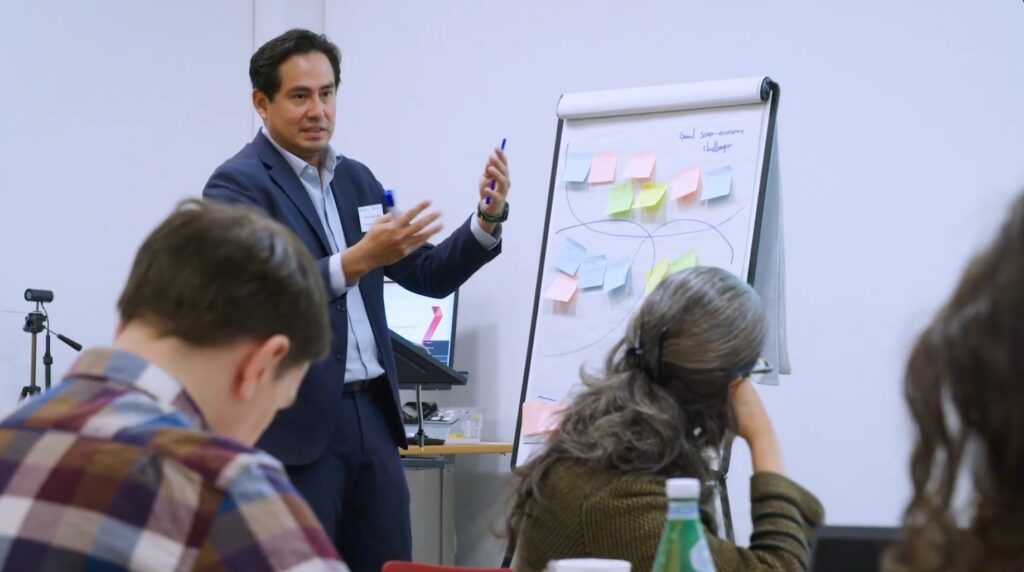
Drawing on international experience, the programme translated global innovation insights into practical tools for day-to-day policymaking.
The course:
- Explored how governments use science, innovation, and technology policy to shape industries and drive
economic growth. - Introduced key concepts in transport innovation policy, combining academic perspectives with real-world examples to highlight what works in practice.
- Used logic models – including Business, Manufacturing, and Supply Chain Readiness Levels – extending beyond traditional Technology Readiness Levels to capture the wider dynamics of innovation systems.
- Explored international approaches to transport innovation and technology policy, comparing how countries including China, South Korea and the United States support innovation through different policy instruments and institutional models.
- Used DfT-relevant examples such as the low-orbit economy, ARPA-style programmes, research and technology organisations, and transport innovation institutes to identify lessons and opportunities
Learning combined conceptual frameworks, practical tools, and peer exchange, helping participants build connections across DfT and apply insights to real policy challenges.
“What I really valued about this course was the flexibility to shape discussions around what mattered most to our work –it felt genuinely bespoke and relevant. Comparing approaches across countries was especially useful as we continued to learn from global innovation policies.”
Nathan Hurdsfield, Head of Innovation,Science Innovation and Technology Division,Department for Transport
The Impact
The programme is beginning to influence how participants think about and approach innovation policy within DfT. Early indications of this shift can be seen in participants’ reflections and intended applications:
- Uptake of practical tools: Logic models emerged as one of the practical tools participants were most keen to apply. Several described plans to use them to help articulate objectives, align activities and communicate the intended impact of their work more clearly. Some participants also expressed interest in more advanced training to build confidence in applying these approaches.
- More strategic, system-oriented approaches: Participants expressed interest in applying more challenge-led framing, alongside a clearer focus on how government can shape markets and coordinate actors. This reflected participants’ interest in moving beyond isolated interventions towards more integrated, mission-oriented approaches to innovation policy.
- Stronger focus on impact: Participants highlighted the importance of defining outcomes upfront, understanding pathways to delivery, and improving how innovation is communicated and “made investable” within government – highlighting these as areas they intended to explore further in their own work.
- Stronger internal collaboration and shared ambition: The programme created opportunities for stronger connections within DfT, strengthening relationships across teams and reinforcing a shared goal to embed innovation more effectively. Participants particularly valued the opportunity to meet colleagues from across different parts of the department, share experiences, and identify potential opportunities for future collaboration.
- Interest in future coordination mechanisms: Participants expressed interest in sustaining collaboration and capturing opportunities more systematically – including proposals such as a dedicated SciTech engagement role to broker connections and maintain momentum.
These reflections were accompanied by strong engagement and positive feedback on the approach.The programme achieved an overall satisfaction score of 4.5/5, with over half of participants rating it at the highest level – indicating participants found the content relevant and applicable to policy challenges.
Cambridge Industrial Innovation Policy helps governments and public organisations build the skills needed to design effective, future-ready industrial and innovation strategies. Our training courses combine cutting-edge research from the University of Cambridge with practical tools, international case studies, and real-world policy experience.
Designed for policymakers, civil servants, and industry leaders, our programmes support evidence-based decision-making, helping investments in science, technology, and innovation deliver tangible economic, social, and environmental impact.
Find out more about our training courses
Get in touch to find out more about connecting with our community