Reports and articles
How ‘little giants’ help China defend its manufacturing dominance
Published on April 9th 2026
*Originally published in the South China Morning Post.
By Zongshuai Fan, Cambridge Industrial Innovation Policy
This blog is also available in Chinese: 中文版
The world sees China’s manufacturing scale. Beijing is eyeing the next phase. The programme “little giants” exemplifies how China is betting on technology-driven SMEs to build technology self-sufficiency, reinforce industrial chains and accelerate “new quality productive forces”.
The trade surplus debate misses Beijing’s real strategy
China posted a record trade surplus of US$1.19 trillion in 2025, including a US$1.08 trillion goods surplus in the first 11 months. Against this backdrop, some have warned that China is “making trade impossible”, arguing that the rest of the world has fewer goods left that it can sell, or is willing to sell, to China. Critics point to Chinese manufacturers’ competitive edge in producing goods that are both better and cheaper.
For Beijing, however, this might feel less like criticism and more like a subtle compliment. It, in many ways, affirms China’s long-term strategy to bolster its global manufacturing stance.
Building industrial strength through a tiered SME support system
Supporting technology-driven small and medium-sized enterprises (SMEs) is a vital part of that strategy. Since the policy concept of targeted SME support was introduced in 2011, authorities have developed a multi-tier framework to identify high-performing firms and direct support to them.
Two tiers are especially consequential: “specialised, refined, distinctive and innovative” firms and “little giants”. The former operates in narrow niches through process know-how, quality upgrades and incremental innovation. The latter are more selective and typically display stronger technological capability, greater market competitiveness and higher growth potential.
During China’s 14th Five-Year Plan period (2021–2025), the number of “specialised” firms rose from fewer than 40,000 to more than 140,000, while “little giants” increased from about 5,000 to over 17,600.
This ladder-like certification and support framework is closely aligned with China’s industrial priorities. Around 75 per cent of “little giants” certified between 2019 and 2022 are involved in the core sectors identified under Made in China 2025. These firms also contribute significantly to technology upgrading and innovation. In 2024, “little giants” recorded average R&D spending of more than RMB 30 million (about US$4.3 million), with reported R&D intensity of about 7 per cent.
Figure 1: Innovative SMES development pyramid, targets and outcomes during the 14th five-year plan period
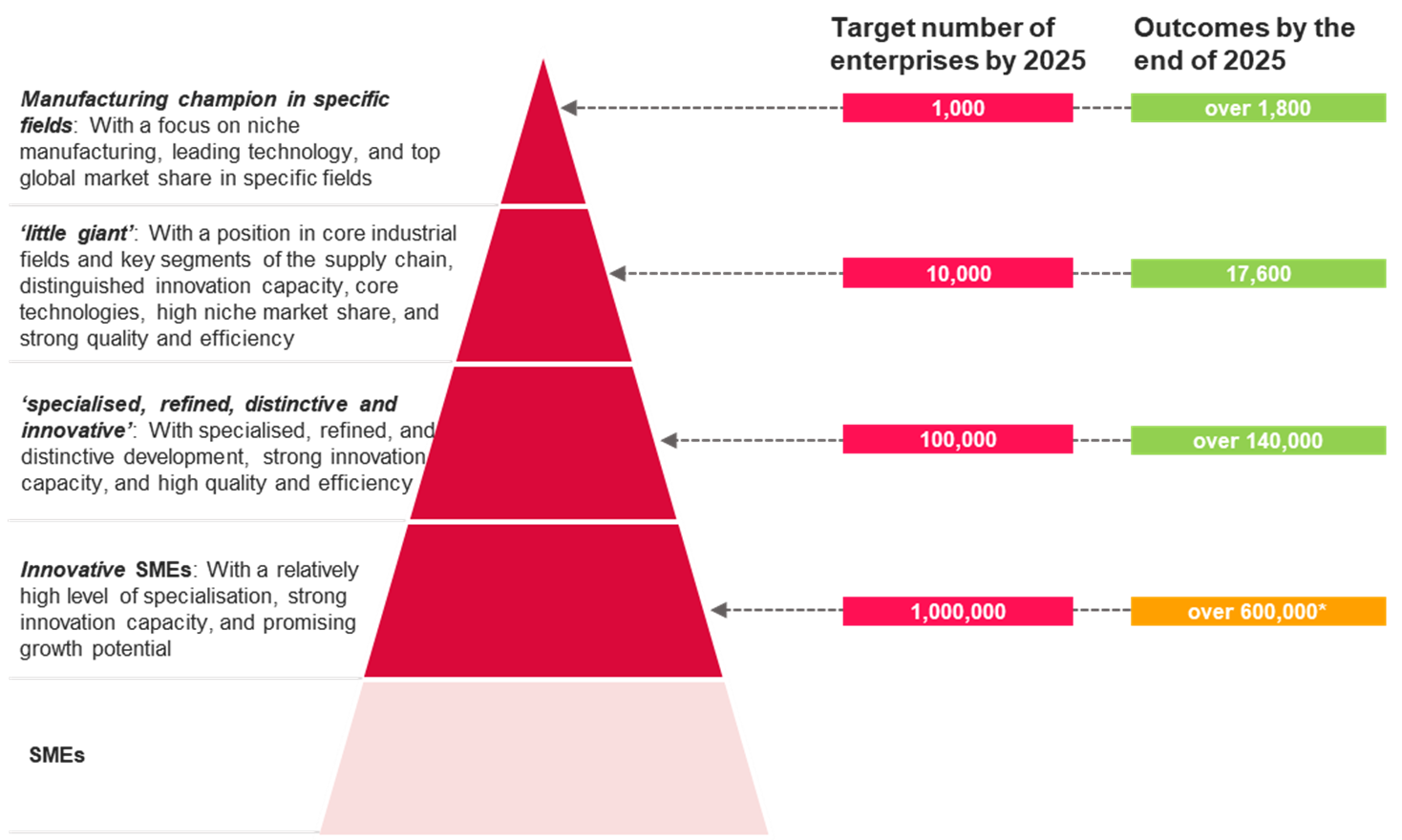
*Note: by the end of 2024
Source: summarised by CIIP based on the news by Xinhua in 2021 and 2025; news by Qiushi in 2025
What Beijing expects: chokepoints, industrial chains and “new quality productive forces”
Beijing’s expectations for these technology-driven SMEs, especially the “little giants”, can be summarised into three main areas. First, they are expected to enhance technological self-sufficiency by addressing “chokepoint” technologies. Second, they are tasked with strengthening the integrity of the industrial chain and the resilience of the supply chain. Third, they are positioned to support the development of “new quality productive forces”.
The “little giant” programme was shaped by China’s “chokepoint” technology concerns in the context of rising US-China frictions after 2018. Three days after Washington imposed sanctions on ZTE in April 2018 by suspending exports of semiconductors and related products to the company, the Ministry of Science and Technology published a “chokepoint” technology list covering 35 fields. In November 2018, the Ministry of Industry and Information Technology (MIIT) announced a policy programme to incubate 600 “little giants” between 2018 and 2020 by selecting from the pool of “specialised” firms. Mastering key technologies was clearly stated as a central objective.
Since then, “little giants” have become important contributors to breakthroughs in “chokepoint” areas. Photoresist, a critical material for semiconductor production, was included on the 35-field list. By 2024, there were 35 “little giants” in this area, with average R&D spending of RMB 127 million (about US$18 million) and average revenue of RMB 1.9 billion (about US$273 million).
“Little giants” are also expected to strengthen the completeness of China’s industrial chain. One major pathway for certification is participation in the “six industrial fundamentals”: core mechanical components, core electronic components, key software, advanced core manufacturing processes, key materials, and industrial technology foundations such as testing platforms. These fundamentals are widely treated by policymakers as the foundation of China’s manufacturing capability.
Official statistics suggest that among the more than 17,600 “little giants” by 2025, over 60 per cent were involved in the six industrial fundamentals, nearly 80 per cent were positioned in key areas of industrial chains, and more than 90 per cent served as suppliers to premier manufacturers in domestic or global markets. Nearly 90 per cent of “little giants” operate in manufacturing.
For firms outside the six industrial fundamentals, another pathway is to demonstrate significant contributions to “new quality productive forces”. This includes upgrading traditional industries, fostering emerging industries and building future industries.
Here, the policy direction is clear. In the CPC Central Committee’s Recommendations for the 15th Five-Year Plan (2026–2030), support for these SMEs is placed alongside the goal of developing emerging and future industries.
As a result, more than 80 per cent of “little giants” are concentrated in emerging industries such as semiconductors and aerospace. Over 6,000 reportedly operate in future industries such as quantum technology and artificial intelligence. Unitree, a cutting-edge robot manufacturer, is often cited as an example. In 2024, its quadruped robots were reported to have captured about 60 per cent of the global market.
With SME support included in the Recommendations, MIIT has signalled that a new round of national policies for technology-driven SMEs is on the way during the next plan period.
What this means beyond China
Strengthening local supply chains is now a priority for many governments, but implementation is proving difficult. Common hurdles include connecting local firms to global lead companies, developing new suppliers for existing industries and building supplier ecosystems for next-generation products.
China’s “little giants” programme shows one way this could be done. Officials have described “little giants” in the new energy value chain, including solar panels and batteries, as a “ballast” that stabilises the sector. The broader lesson is that SMEs operating in cross-cutting technology fields could form the foundation of national manufacturing capability.
Beijing’s message is consistent: it does not intend to step back from strengthening industrial capacity. For China’s trade partners, the implication is clear. Instead of asking China to change its course, they should be inspired by China and focus on developing the necessary state capacity to deliver industrial programmes with comparable granularity and long-term consistency.
Get in touch to find out more about working with us